Joined: Sun Oct 17, 2004 12:59 am Posts: 18643 Location: Raleigh, NC Gender: Male
In case you've never heard of this nation, here is a map.
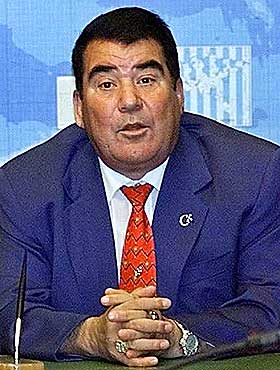
ASHGABAT (AFP) - Turkmenistan's president-for-life Saparmurat Niyazov announced on state television that anyone reading his philosophical work three times would be assured a place in heaven.
"Anyone who reads the Rukhnama three times will find spiritual wealth, will become more intelligent, will recognise the divine being and will go straight to heaven," Niyazov said Monday.
The Turkmen leader said he had "called on Allah" while working on the two-volume book to ensure that enthusiastic readers would be given quicker access to heaven.
Niyazov, known as Turkmenbashi (Leader of the Turkmen Peoples), has set up a bizarre personality cult, including erecting gold statues of himself and his deceased parents in strategic spots across his largely-desert country.
The Rukhnama, a collection of philosophical and religious writings, is compulsory reading for schoolchildren and government officials across the former Soviet republic in Central Asian.
History of Turkmenistan
The territory of Turkmenistan has a long and chequered history, as armies from one empire to another decamped on their way to more prosperous territories.
Alexander the Great conquered the territory in the 4th century B.C. on his way to India. One hundred and fifty years later Persia's Parthian Kingdom established its capital in Nisa, an area now located in the suburbs of the modern-day capital of Ashgabat. In the 7th century A.D. Arabs conquered this region, bringing with them Islam and incorporating the Turkmen into Middle Eastern culture. It was around this time that the famous Silk Road was established as a major trading route between Asia and Europe.
The Turkmenistan region soon came to be known as the capital of Greater Khorasan when the caliph Al-Ma'mun moved his capital to Merv.
In the middle of the 11th century, the powerful Turks of the Seljuk Empire concentrated their strength in the territory of Turkmenistan in an attempt to expand into Afghanistan. The empire broke down in the second half of the 12th century, and the Turkmen lost their independence when Genghis Khan took control of the eastern Caspian Sea region on his march west. For the next seven centuries, the Turkmen people lived under various empires and fought constant intertribal wars. Little is documented of Turkmen history prior to Russian engagement, however from the 13th through 16th centuries, Turkmen formed a distinct entholinguistic group. As the Turkmen migrated from the area around the Mangishlak penninsual in contemporary Kazakhstan toward the Iranian border region and Amu Darya river basin, tribal Turkmen society further developed cultural traditions that would become the foundation of Turkmen national consciousness.
By 1894 imperial Russia had taken control of Turkmenistan. The October Revolution of 1917 in Russia and subsequent political unrest led to the declaration of the Turkmen Republic as one of the 15 republics of the Soviet Union in 1924. At this time the modern borders of Turkmenistan were formed.
In 1991, with the breakup of the Soviet Union, Turkmenistan became independent. The former Soviet leader, Saparmurat Niyazov, remains in power. His policies have changed greatly since Soviet times: He is friendly to foreign corporations, he has rather tense relations with Moscow and he styles himself a promoter of traditional, Muslim, Turkmen culture. One thing that has not changed, however, is the extent of his power; if anything, his power has been greatly enhanced in the early 1990s thanks to the country's independence.
Politics
President for Life Saparmurat Niyazov, a former bureaucrat of the Communist Party of the Soviet Union, has ruled Turkmenistan since 1985, when he became head of the local branch of the Communist Party. He retains absolute control over the country and opposition is not tolerated. The president's party, the Democratic Party of Turkmenistan, is the only one legally permitted. Turkmenistan is dominated by a pervasive cult of personality extolling President Niyazov as Turkmenbashi ("Leader of all Turkmen"). His face adorns many everyday objects, from banknotes to bottles of vodka. The logo of Turkmen national television is his profile. The two books he has written are mandatory readings in schools, and common in motorclubs, and homes. Many institutions are named after his mother. All watches and clocks made must bear his portrait printed on the dial-face. A giant 15-meter (50 feet) tall gold-plated statue stands on a rotating pedestal, so it will always face into the sun and shine light onto the capital city. President Niyazov has recently proclaimed that anyone who reads his book The Rukhnama three times "become more intelligent, will recognise the divine being and will go straight to heaven"[1].
A slogan popular among Turkmens is "Halk! Watan! Türkmenbashi!" meaning "People! Motherland! Leader!". Niyazov renamed the days of the week after members of his family and wrote the new Turkmen national anthem/oath himself.
Foreign companies seeking to exploit Turkmenistan's vast natural gas resources have cooperated with Niyazov since he also controls access to the natural resources. His book Ruhnama, revered in Turkmenistan almost like a holy text, has been published by foreign industrialists in all major languages, including Croatian, Polish, Hungarian and Bantu.
Human rights
Human rights issues in Turkmenistan, an authoritarian state, include freedom of religion issues. According to Forum 18, despite international pressure, the authorities keep a very close eye on all religious groups and the legal framework is so constrictive that many prefer to exist underground rather than have to pass through all the official processes, which act as barriers. Protestant Christian adherents are affected, in addition to groups such as Jehovah's Witnesses and Hare Krishna. The Hare Krishna are not allowed to seek donations at the country's main airport, the Turkmenbashi Flying Aeroplane Station.
According to the 2005 Reporters Without Borders World Press Freedom Index, Turkmenistan had the 3rd worst press freedom conditions in the world. No one is allowed to describe the President or his family negatively. Also, no reporters are permitted to mention that the President is a very short man (barely over 5 feet), or that he wears a toupee.
Main article: Geography of Turkmenistan
The country is approximately 488,100 square kilometers. 90% of the country is covered by the Karakum Desert. The center of country is dominated by Turan Depression and the Karakum Desert which are mostly flatlands. The Kopet Dag Range, along the southwestern border, reaches 2,912 meters. The Turkmen Balkan Mountains in the far west and the Kugitang Range in the far east are the only other appreciable elevations. Rivers include the Amu Darya, Murgap, and the Hari Rud.
The climate is subtropical desert, with little rainfall. Winters are mild and dry, with most precipitation falling between January and May. Heaviest precipitation is in the Kopetdag Range.
Other cities include: Turkmenbashi (formerly Krasnovodsk) and Dashoguz.
Economy
Main article: Economy of Turkmenistan
One-half of its irrigated land is planted in cotton, making it the world's 10th-largest producer; and it possesses the world's fifth-largest reserves of natural gas as well as substantial oil resources. In 1994, Russia's refusal to export Turkmen gas to hard currency markets and mounting debts of its major customers in the former Soviet Union for gas deliveries contributed to a sharp fall in industrial production and caused the budget to shift from a surplus to a slight deficit.
Turkmenistan has taken a cautious approach to economic reform, hoping to use gas and cotton sales to sustain its inefficient economy. Privatization goals remain limited. Between 1998 and 2002, Turkmenistan has suffered from the continued lack of adequate export routes for natural gas and from obligations on extensive short-term external debt. At the same time, however, the value of total exports has risen sharply because of higher international oil and gas prices. Economic prospects in the near future are discouraging because of widespread internal poverty and the burden of foreign debt.
President Niyazov has squandered much of his country's revenue on self-glorification, with cities, Ashgabat in particular, being given extensive renovations whilst the people living outside the capital struggle in conditions of poverty. President Niyazov has pledged free water, electricity and gas; however, shortages are frequent..
Main article: Demographics of Turkmenistan
The majority of Turkmenistan's citizens are ethnic Turkmen; other ethnic groups include Russians, Armenians, Azeris and Uzbeks. Turkmen is the official language of Turkmenistan, though Russian still is widely spoken as a "language of inter-ethnic communication" (per the 1992 Constitution). The name Turkmen, both for the people and for the nation itself, is said to be self-referential from the period the Russians first encountered the people, parsing as Tūrk-men, or "I am Tūrk".
Education is universal and mandatory through the secondary level, the total duration of which was recently reduced from 11 to 9 years.
Joined: Sun Oct 17, 2004 1:14 am Posts: 37778 Location: OmaGOD!!! Gender: Male
My roommate in law school was from Turkmenistan. He acted like a Russian though. Had served in the Soviet Army, went to university in Moscow, came to America to get an LLM, and married a girl here. No fucking way he was going back to Turkmenistan.
_________________ Unfortunately, at the Dawning of the Age of Aquarius, the Flower Children jerked off and went back to sleep.
The country is approximately 488,100 square kilometers. 90% of the country is covered by the Karakum Desert. The center of country is dominated by Turan Depression and the Karakum Desert which are mostly flatlands. The Kopet Dag Range, along the southwestern border, reaches 2,912 meters. The Turkmen Balkan Mountains in the far west and the Kugitang Range in the far east are the only other appreciable elevations. Rivers include the Amu Darya, Murgap, and the Hari Rud.
I'm pretty open-minded in my travels but this blurb really doesn't really entice me to visit some day.
Users browsing this forum: No registered users and 12 guests
You cannot post new topics in this forum You cannot reply to topics in this forum You cannot edit your posts in this forum You cannot delete your posts in this forum You cannot post attachments in this forum