Joined: Sun Oct 17, 2004 3:11 am Posts: 6822 Location: College Station, TX, USA Gender: Male
This is one of my favorite problems in discrete mathematics. The formulation is thus:
You're on a game show trying to win a car. There are three doors in front of you. Behind one door is the car and behind the other two are goats. There is no way to tell one door apart from another to discern what is behind them. The host, who knows what is behind each door, asks you to select a door. After you do so, the host opens one of the other two remaining doors, revealing a goat. You are then given the option of switching your selection to the other unopened door. After this final choice, your door is opened and you will win whatever is behind it. Is it probabilistically favorable to switch doors or to stick with your original choice (or is there no difference)?
It seems that it should make no difference in terms of probability. There are three doors and one car so you have a 1/3 chance of picking the car. While this is true initially, the host opening a losing door counter-intuitively changes the situation, creating the paradox. According to the probability, switching doors would lead to winning the car 2/3 of the time. Here's why.
There's three possible situations created when you first select a door. Either you've selected the car, goat #1, or goat #2.
If you've selected the car initially, the host will either reveal goat #1 or goat #2 (which one is revealed is irrelevant). Here, switching doors would lead to a loss. If you've selected goat #1, the host will reveal goat #2. Here, switching doors wins the car. If you've selected goat #2, the host will reveal goat #1. Here, switching doors also wins the car.
Therefore, in 2 out of 3 of these situations, switching doors wins would make you win the car.
Confused yet?
Consider the case where the host doesn't know what's behind the doors. In this case, switching doors would have no advantage over sticking with your original selection. Without knowing where the goats are, there's no guarantee that the host will reveal a goat so the probability of the car being behind the two still closed doors is equal, either 1/2 or 0 if the car was behind the opened door.
Joined: Thu Apr 14, 2005 3:13 am Posts: 4932 Location: SEX MAKES BABIES?!
I remember we had this question in math class. I was sure the answer was wrong, and never did get a proper explanation. But you did a much better job than my math teacher
_________________ What I'm currently watching: Two Hot Lesbians in Double Loving Hot Spa Outing Extravaganza
Joined: Sat Oct 16, 2004 10:51 pm Posts: 14534 Location: Mesa,AZ
ManiacalClown wrote:
This is one of my favorite problems in discrete mathematics. The formulation is thus:
You're on a game show trying to win a car. There are three doors in front of you. Behind one door is the car and behind the other two are goats. There is no way to tell one door apart from another to discern what is behind them. The host, who knows what is behind each door, asks you to select a door. After you do so, the host opens one of the other two remaining doors, revealing a goat. You are then given the option of switching your selection to the other unopened door. After this final choice, your door is opened and you will win whatever is behind it. Is it probabilistically favorable to switch doors or to stick with your original choice (or is there no difference)?
It seems that it should make no difference in terms of probability. There are three doors and one car so you have a 1/3 chance of picking the car. While this is true initially, the host opening a losing door counter-intuitively changes the situation, creating the paradox. According to the probability, switching doors would lead to winning the car 2/3 of the time. Here's why.
There's three possible situations created when you first select a door. Either you've selected the car, goat #1, or goat #2.
If you've selected the car initially, the host will either reveal goat #1 or goat #2 (which one is revealed is irrelevant). Here, switching doors would lead to a loss. If you've selected goat #1, the host will reveal goat #2. Here, switching doors wins the car. If you've selected goat #2, the host will reveal goat #1. Here, switching doors also wins the car.
Therefore, in 2 out of 3 of these situations, switching doors wins would make you win the car.
Confused yet?
Consider the case where the host doesn't know what's behind the doors. In this case, switching doors would have no advantage over sticking with your original selection. Without knowing where the goats are, there's no guarantee that the host will reveal a goat so the probability of the car being behind the two still closed doors is equal, either 1/2 or 0 if the car was behind the opened door.
WRONG
Quote:
If you've selected the car initially, the host will either reveal goat #1 or goat #2 (which one is revealed is irrelevant). Here, switching doors would lead to a loss. If you've selected goat #1, the host will reveal goat #2. Here, switching doors wins the car. If you've selected goat #2, the host will reveal goat #1. Here, switching doors also wins the car.
Therefore, in 2 out of 3 of these situations, switching doors wins would make you win the car.
It is true that in 2 out of 3 of those situations, switching doors would make you win, but there is some faulty logic there. Basically, the cause and effect here is mixed up, because there is a 50% chance that the car being behind the door is the situation you have. The problem is you're treating the two goats like they're different. If the host opens the first door and it's a goat, the following is true:
* There is a 50% chance that the car is behind the second door. * There is a 50% chance that a goat is behind the second door. * There is a 50% chance that goat is Goat A and a 50% chance that goat is Goat B.
So, really, there's a 50% chance the car is behind the door, a 25% chance Goat A is behind the door, and a 25% chance Goat B is behind the door. While it is true that 2 of those 3 situations would make you win, there is only a 50% chance that you have one of those 2 situations.
If you look at it another way, when you make your original choice, the car CLEARLY has an equal chance of being behind the three doors. That means there is an EQUAL probability of the car being behind doors 2 and 3. When door 1 is opened, there is STILL an equal probability of the car being behind doors 2 and 3.
_________________
John Adams wrote:
In my many years I have come to a conclusion that one useless man is a shame, two is a law firm, and three or more is a congress.
Joined: Sun Oct 17, 2004 3:11 am Posts: 6822 Location: College Station, TX, USA Gender: Male
$úñ_DëV|L wrote:
ManiacalClown wrote:
This is one of my favorite problems in discrete mathematics. The formulation is thus:
You're on a game show trying to win a car. There are three doors in front of you. Behind one door is the car and behind the other two are goats. There is no way to tell one door apart from another to discern what is behind them. The host, who knows what is behind each door, asks you to select a door. After you do so, the host opens one of the other two remaining doors, revealing a goat. You are then given the option of switching your selection to the other unopened door. After this final choice, your door is opened and you will win whatever is behind it. Is it probabilistically favorable to switch doors or to stick with your original choice (or is there no difference)?
It seems that it should make no difference in terms of probability. There are three doors and one car so you have a 1/3 chance of picking the car. While this is true initially, the host opening a losing door counter-intuitively changes the situation, creating the paradox. According to the probability, switching doors would lead to winning the car 2/3 of the time. Here's why.
There's three possible situations created when you first select a door. Either you've selected the car, goat #1, or goat #2.
If you've selected the car initially, the host will either reveal goat #1 or goat #2 (which one is revealed is irrelevant). Here, switching doors would lead to a loss. If you've selected goat #1, the host will reveal goat #2. Here, switching doors wins the car. If you've selected goat #2, the host will reveal goat #1. Here, switching doors also wins the car.
Therefore, in 2 out of 3 of these situations, switching doors wins would make you win the car.
Confused yet?
Consider the case where the host doesn't know what's behind the doors. In this case, switching doors would have no advantage over sticking with your original selection. Without knowing where the goats are, there's no guarantee that the host will reveal a goat so the probability of the car being behind the two still closed doors is equal, either 1/2 or 0 if the car was behind the opened door.
WRONG
Quote:
If you've selected the car initially, the host will either reveal goat #1 or goat #2 (which one is revealed is irrelevant). Here, switching doors would lead to a loss. If you've selected goat #1, the host will reveal goat #2. Here, switching doors wins the car. If you've selected goat #2, the host will reveal goat #1. Here, switching doors also wins the car.
Therefore, in 2 out of 3 of these situations, switching doors wins would make you win the car.
It is true that in 2 out of 3 of those situations, switching doors would make you win, but there is some faulty logic there. Basically, the cause and effect here is mixed up, because there is a 50% chance that the car being behind the door is the situation you have. The problem is you're treating the two goats like they're different. If the host opens the first door and it's a goat, the following is true:
* There is a 50% chance that the car is behind the second door. * There is a 50% chance that a goat is behind the second door. * There is a 50% chance that goat is Goat A and a 50% chance that goat is Goat B.
So, really, there's a 50% chance the car is behind the door, a 25% chance Goat A is behind the door, and a 25% chance Goat B is behind the door. While it is true that 2 of those 3 situations would make you win, there is only a 50% chance that you have one of those 2 situations.
If you look at it another way, when you make your original choice, the car CLEARLY has an equal chance of being behind the three doors. That means there is an EQUAL probability of the car being behind doors 2 and 3. When door 1 is opened, there is STILL an equal probability of the car being behind doors 2 and 3.
Joined: Sat Oct 16, 2004 10:51 pm Posts: 14534 Location: Mesa,AZ
ManiacalClown wrote:
$úñ_DëV|L wrote:
ManiacalClown wrote:
This is one of my favorite problems in discrete mathematics. The formulation is thus:
You're on a game show trying to win a car. There are three doors in front of you. Behind one door is the car and behind the other two are goats. There is no way to tell one door apart from another to discern what is behind them. The host, who knows what is behind each door, asks you to select a door. After you do so, the host opens one of the other two remaining doors, revealing a goat. You are then given the option of switching your selection to the other unopened door. After this final choice, your door is opened and you will win whatever is behind it. Is it probabilistically favorable to switch doors or to stick with your original choice (or is there no difference)?
It seems that it should make no difference in terms of probability. There are three doors and one car so you have a 1/3 chance of picking the car. While this is true initially, the host opening a losing door counter-intuitively changes the situation, creating the paradox. According to the probability, switching doors would lead to winning the car 2/3 of the time. Here's why.
There's three possible situations created when you first select a door. Either you've selected the car, goat #1, or goat #2.
If you've selected the car initially, the host will either reveal goat #1 or goat #2 (which one is revealed is irrelevant). Here, switching doors would lead to a loss. If you've selected goat #1, the host will reveal goat #2. Here, switching doors wins the car. If you've selected goat #2, the host will reveal goat #1. Here, switching doors also wins the car.
Therefore, in 2 out of 3 of these situations, switching doors wins would make you win the car.
Confused yet?
Consider the case where the host doesn't know what's behind the doors. In this case, switching doors would have no advantage over sticking with your original selection. Without knowing where the goats are, there's no guarantee that the host will reveal a goat so the probability of the car being behind the two still closed doors is equal, either 1/2 or 0 if the car was behind the opened door.
WRONG
Quote:
If you've selected the car initially, the host will either reveal goat #1 or goat #2 (which one is revealed is irrelevant). Here, switching doors would lead to a loss. If you've selected goat #1, the host will reveal goat #2. Here, switching doors wins the car. If you've selected goat #2, the host will reveal goat #1. Here, switching doors also wins the car.
Therefore, in 2 out of 3 of these situations, switching doors wins would make you win the car.
It is true that in 2 out of 3 of those situations, switching doors would make you win, but there is some faulty logic there. Basically, the cause and effect here is mixed up, because there is a 50% chance that the car being behind the door is the situation you have. The problem is you're treating the two goats like they're different. If the host opens the first door and it's a goat, the following is true:
* There is a 50% chance that the car is behind the second door. * There is a 50% chance that a goat is behind the second door. * There is a 50% chance that goat is Goat A and a 50% chance that goat is Goat B.
So, really, there's a 50% chance the car is behind the door, a 25% chance Goat A is behind the door, and a 25% chance Goat B is behind the door. While it is true that 2 of those 3 situations would make you win, there is only a 50% chance that you have one of those 2 situations.
If you look at it another way, when you make your original choice, the car CLEARLY has an equal chance of being behind the three doors. That means there is an EQUAL probability of the car being behind doors 2 and 3. When door 1 is opened, there is STILL an equal probability of the car being behind doors 2 and 3.
Mathematics disagrees with you.
I'm going to simulate this to see if it really holds.
_________________
John Adams wrote:
In my many years I have come to a conclusion that one useless man is a shame, two is a law firm, and three or more is a congress.
Joined: Sat Oct 16, 2004 11:53 pm Posts: 2918 Location: Right next door to hell.
$úñ_DëV|L wrote:
If you look at it another way, when you make your original choice, the car CLEARLY has an equal chance of being behind the three doors.
No. When you make your first choice, there's a 1/3 chance that you've picked the car, and 2/3 chance that you've picked a goat. Actually, reading again I agree with you that ManiacalClown is wrong. You can't increase your odds above 50% when choosing from 2 doors. You are simply increasing your odds from 33% to 50%.
This can be used practically with the game show Deal or No Deal. When a person picks a briefcase at the beginning of the game, there is a 1/100 chance that they've chosen $1 million. If they managed to narrow things down to two cases, the probability that they're holding the $1 million dollar case is still 1%, but if they chose to switch cases, they'd be increasing their odds to 50%.
_________________ There's just 2 hours left until you find me dead.
Last edited by owen meany on Tue Feb 12, 2008 5:05 pm, edited 1 time in total.
Joined: Sat Oct 16, 2004 10:51 pm Posts: 14534 Location: Mesa,AZ
Yeah, it holds in simulation.
I like this explanation better:
The probability that you originally picked the car is *still* 1/3. The probability that one of those other two doors was the car is *still* 2/3.
So you have a new problem: The probability that there is a car behind Door A or Door B is 2/3. There is a goat behind Door B. So what is the probability that there is a car behind Door A?
I think that's a more intuitive way of looking at it.
_________________
John Adams wrote:
In my many years I have come to a conclusion that one useless man is a shame, two is a law firm, and three or more is a congress.
Joined: Sun Oct 17, 2004 3:11 am Posts: 6822 Location: College Station, TX, USA Gender: Male
Your way of looking at it is correct. The key is that when you choose a door initially, there's a 1/3 chance that it holds a car. The other two doors combined have a 2/3 chance of holding a car. Since you're guaranteed to have a goat revealed by the host behind one of those two unselected doors, the other door continues to have a 2/3 chance of having the car behind it. The paradox is that you have a 1/3 versus a 2/3 chance despite only two possible outcomes.
The Deal or No Deal analogy is another interesting thing to look at because it's closely related to the Monty Hall problem. The difference here is that the host does not know what is contained in the cases and the contested him or herself is making the selections. When you initially select your case, there's a 1/26 chance that it holds the million (this is different for the Million Dollar Mission thing, in which case you would need to consider each $1 million case as a unique element and say there's a 1/26 chance that the player holds one particular winning case). As more and more cases are opened, the probability that a particular value is in the contestant's case does change. This is because there's no guarantee that any particular value is going to be revealed at any particular time. In the Monty Hall problem, there will ALWAYS be a goat revealed by the host opening one of the unselected doors. Meanwhile, on Deal or No Deal, there's always the chance that the contested selected a case to open will reveal $1 million, instantly dropping the chances of their own case containing that value to 0. If the contested manages to get it down to 2 cases with the million still on the board, the chances for each case holding the million is 1/2. Therefore, there is no statistical advantage to switching cases.
This is why the host not knowing what's behind the doors fundamentally changes the Monty Hall problem. By not knowing what is going to be revealed, there is no guarantee that a goat will be revealed. Therefore, the probabilities for the two remaining doors change based on what is revealed. If a goat is revealed, the probability for either door is 1/2 that there is a car behind it. If the car is revealed, it drops to 0 for both.
Joined: Sun Oct 17, 2004 3:11 am Posts: 6822 Location: College Station, TX, USA Gender: Male
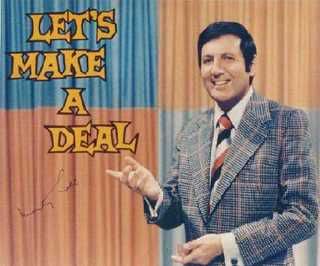
And yes, for our non-American friends, this problem is so named because it's loosely based on the game show Let's Make a Deal which was hosted by Monty Hall.
If Monty has no clue what is behind the door he's about to open, then the problem looks like this:
You = 1/3 chance of being the car Monty = 1/3 chance of being the car Other = 1/3 chance of being the car
Here, the probability of you being correct with your choice (event A) given monty didn't get the car with his choice (event B), is, by the Conditional Probability formula:
Probability (A given B happened) = Prob (B then A happening without knowledge that B happened) / Prob (B happening all on its own)
What is Prob (B then A happening without knowledge of B)? In other words, what's the probability that Monty gets his choice wrong, and then you get your choice right, in sequence, NOT GIVEN THE FACT THAT YOU KNOW HE'S WRONG (let's suppose you're blindfolded for instance)?
Prob (B happening and then A happening), i.e. the probability that Monty draws a goat (2/3) AND that you draw a car without being privy to the information on what Monty drew (but knowing he could have drawn your car, leaving you with 1/3 on one door and 1/3 on the other and 1/3 that Monty drew the car already, leaving you with a 1/2 chance) is: (2/3)*(1/2).
The probability that Monty gets something other than a car, no matter what the future holds: 2/3.
Thus by Conditional Probability, P (A given B) = (2/3)*(1/2) / (2/3) = 1/2 or 50 percent. In the case that Monty does not know in the first place whether his door choice holds a car behind it or a goat, switching the door does not matter in the case where you are given that Monty has revealed a goat door that isn't yours.
-----------------
NOW, consider the case where Monty knows where the car is. You pick one of the three doors. Monty picks a door that isn't yours without any risk of revealing the car, and Monty says his knowledge to you that he knows where the car is. He opens the goat door across from you and then asks you whether you want to switch or keep your door.
Now, P(B and then A occurring), meaning the probability that Monty's door has a goat and that your door is correct (under the somewhat absurd sounding assumption that you "do not know" what Monty reveals, only that he reveals something other than a car) is now 1 (Monty reveals a goat 100%) times 1/3 (since the only thing you know is that Monty WILL reveal a car in a door that isn't yours, all that's left is that you don't know whether the goat behind the door he opens will be Goat Harry or Goat Gruff - in other words, the fact that Monty will infallibly pick a goat in another door does not change the likelihood that your door is correct at all)
What's the probability that Monty gets something other than a car, period? 1.
Thus,
Prob (A given B happened), i.e. the probability of your choice winning given Monty opened the door to reveal a goat, given you know beforehand Monty is infallible and won't open up the car on you, is:
P(A given B happened) = P (B happening followed by A happening without knowledge of B's result other than it's not the car) / P (B not choosing the car) = (1/3) / (1) = 1/3.
Thus it is best to choose the other door.
-------
To make things easier, consider a naked Green Habit behind one of ten million doors with the rest being empty. God knows which door Naked GH is behind, and you know that God won't open a door to reveal Naked GH. Being a benevolent God, He lets you choose randomly and fairly, and you pick Door Number 1. God opens all of the rest of the doors, conspicuously skipping Door 3,141,592. Guess what the overwhelming odds of finding GH are if you switch to that door!
Now if you knew that God DID NOT know which door GH was behind, you picked Door Number 1, and God skips 3,141,592 after getting that far by pure chance, he'll likely randomly open up the door on poor Naked GH somewhere further down the line. And if God, with the chance of opening the door on Naked GH looming, just gets lucky enough to leave your Door Number 1 and Door 3,141,592 left with the rest being empty by an incredible stroke of luck (since God, not knowing which door GH is behind, is much more than likely - 9,999,998/9,999,999 - to reveal him behind a door that isn't yours before he eliminates all of the 9,999,999 doors down to just one apart from yours), THEN your choice is 1 in 2 of which door has delicious naked GH.
The question doesn't specify what Monty does or does not know, and that info is crucial.
Users browsing this forum: No registered users and 25 guests
You cannot post new topics in this forum You cannot reply to topics in this forum You cannot edit your posts in this forum You cannot delete your posts in this forum You cannot post attachments in this forum